Project Overview
Motivation
Most voice assistants feel like black boxes. They can give inconsistent responses, misunderstand basic requests, and give you very little visibility into what actually happened when something goes wrong. Furthermore, there are growing concerns about data collection and the ever-present anxiety of your Alexa or Google Home listening into your conversations. Most smart homes nowadays can become very complex. Security systems, remote-access locks, baby monitors and doorbell cameras are among the most privacy sensitive devices in your home. Information about these devices should exclusively live on your private network and must never be exposed to the broader internet only to be used as context for AI inference.
Where we are heading?
By 2029 EU law will mandate solar panel installation on every new home construction. This movement towards moving off the grid has been motivated not only by legislation but by the appeal of independence from the grid.
In a similar way, there is a freeing feeling to having your home assistant independent from the cloud. When your internet goes down, most home assistants become completelty useless because they rely entirely on the cloud for processing and reasoning. As AI compute becomes cheaper and more efficient, we no longer need huge data centers to run powerful models.
The goal is to maximise privacy and minimise response latency. This is achieved by keeping all processing and data within your private network
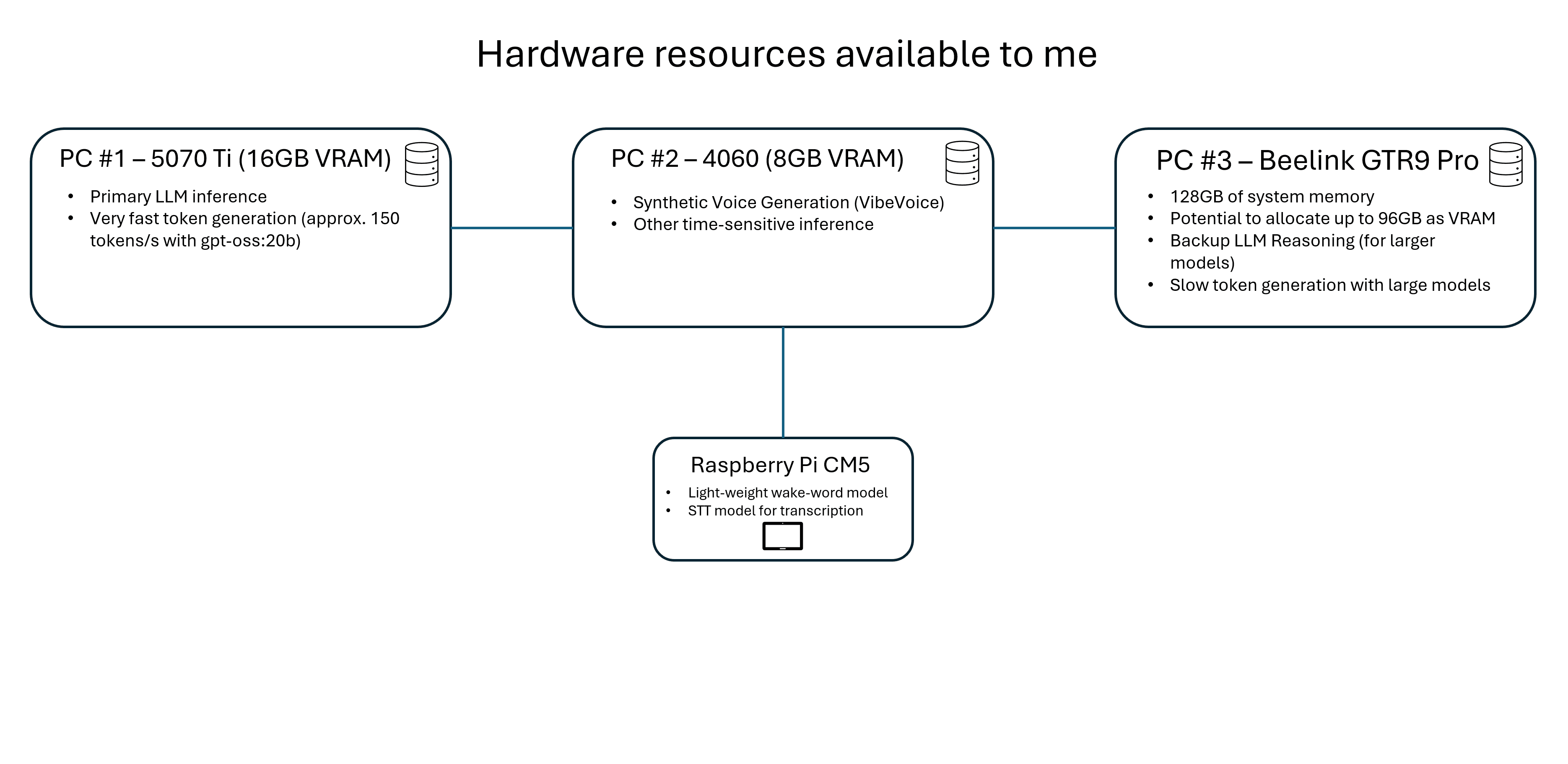
Each part (wake-word, reasoning, voice generation, UI, etc) can be swapped, upgraded, or tested independently. Various suites of models can be used to fit different hardware constraints.
Unlike modern home assistants, Ella is something you can instrument. Timestamps, probabilities, partial outputs can all be observed and debugged in the dashboard.
My implementation: and ambition of a generalised solution
System Architecture